On March 28th, the Mass Defense Committee hosted a CLE on restorative justice and abolition, to an overflowing room of more than 50 participants. Emmanuel Andre of Circles and Ciphers was in discussion with Page May of Assata’s Daughters, and Sharlyn Grace of the Chicago Community Bond Fund moderated.
Starting out with defining restorative justice and abolition, Andre said restorative justice requires “switching the lens,” because it should not be program-based but how we approach the world, with a focus on addressing harm and what’s needed for people to be whole again. May named that “abolition is a project of Black liberation specifically.” She said that to abolish the prison industrial complex (PIC) it is necessary to abolish anti-blackness; to critique the PIC one must critique capitalism and settler-colonialism.
The speakers touched on much of they day-to-day work of building an abolitionist world, including tasks that are less glamorous and visible. May said “abolition is not tomorrow” and both speakers advised the audience of action steps they can take now as part of an abolitionist vision. May emphasized the importance of creating counter-narratives on prisons and police, with actions such as disrupting racism at CAPS meetings or putting signs up saying “We DON’T call police.” Andre’s closing advice included, “Build relationships, not institutions. Don’t leave your imagination behind.”


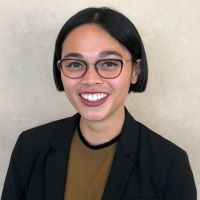 Farolan is a 1L at Northeastern University School of Law and a proud daughter of Filipino immigrants. After graduating from Northwestern University with a degree in Social Policy, she completed an AmeriCorps year of service for the Legal Assistance Foundation. At LAF, she organized volunteer opportunities for attorneys and law students and assisted in management of a pro bono legal services clinic in Chicago’s Uptown neighborhood. In law school, she is a co-chair of the Asian Pacific American Law Students Association. She is also a member of the Criminal Law Project, with whom she has been researching campus police authority and misconduct. Christine hopes to use her career to further criminal legal reform and is eager to work with the Chicago Community Bond Fund as a Haywood Burns fellow.